
Australian English is a globally recognized dialect of English that has evolved independently from its British roots over the past two centuries. While it shares much of its grammar and vocabulary with British and American English, it also features a distinct phonological system, idiomatic expressions, and vocabulary that make it a unique variety of the language.
For speech-language pathologists and educators in the U.S., understanding Australian English speech and language development is important when assessing students who recently moved from Australia or come from Australian-speaking households. Misinterpreting dialectal differences—particularly in vowel pronunciation, intonation, or vocabulary—can lead to inaccurate diagnoses or inappropriate educational placements.
This article explores how Australian English grammar and phonology differ from Standardized American English (SAE), providing examples and comparisons to help professionals distinguish between dialectal variation and true speech or language disorders.
Overview of the Australian English Dialect
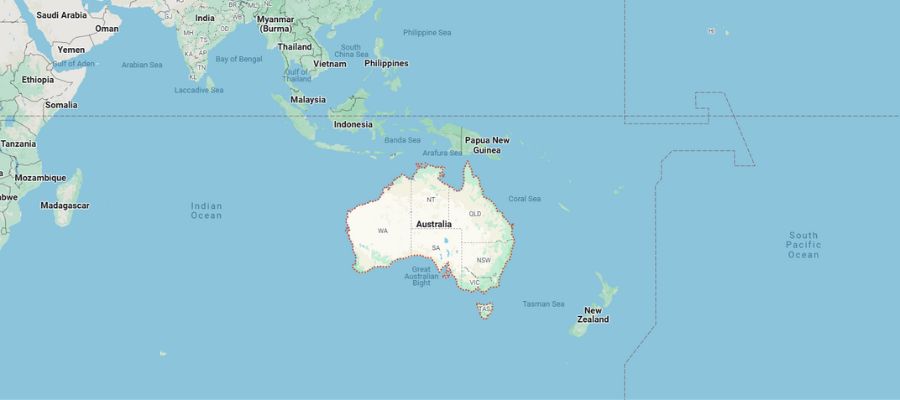
- Geographic Reach: Spoken throughout Australia and in Australian diaspora communities, including parts of New Zealand, Southeast Asia, and the UK.
- Historical Influences: Evolved from 18th and 19th-century British English, particularly Cockney and Irish accents, combined with some influence from Aboriginal languages.
- Variations: Includes three broad accents—Broad, General, and Cultivated—ranging from working-class to more British-sounding varieties.
- Cultural Relevance: Strongly tied to Australian identity, featuring unique slang, idioms, and phonetic shifts.
- Educational Note: Understanding these dialect features helps avoid pathologizing typical variations, especially when evaluating speech intelligibility or language structure.
Phonological Features of Australian English Speech
Australian English speech is especially distinct in its vowel system and prosody. The following chart outlines how it differs from SAE:
| Phonological Feature | Australian English Example | SAE Equivalent | Notes |
|---|---|---|---|
| Vowel Shift /ɪ/ | “bit” sounds like “beet” | [ɪ] vs [i] | High front vowel is raised |
| Diphthong variation /eɪ/ | “mate” sounds like “mite” | /eɪ/ → /æɪ/ | Diphthongs have a stronger front vowel glide |
| Non-rhoticity | “car” → /kaː/ | /kɑr/ | /r/ is dropped post-vocalically |
| T-flapping | “butter” → “budder” | Common in SAE too | Present in General and Broad accents |
| High rising intonation (HRT) | Statements sound like questions | Flat intonation | Common in discourse, not disordered |
| Elision of final sounds | “going” → “goin’” | Also seen in casual SAE | More pronounced and accepted in AusE |
Grammatical Differences Between Australian English and SAE
Australian English grammar is largely similar to SAE, but a few structures and lexical choices may differ in ways relevant to SLPs and educators.
| Grammatical Feature | Australian English Example | SAE Equivalent | Notes |
|---|---|---|---|
| Present perfect usage | “I’ve just eaten” | “I just ate” | More consistent use of present perfect |
| Use of collective nouns | “The team are winning” | “The team is winning” | Follows British convention |
| Lexical differences (verbs) | “to dob someone in” | “to snitch” | Different idiomatic expressions |
| Diminutives and clipped forms | “arvo” (afternoon), “brekkie” (breakfast) | Full forms in SAE | Common and systematic in AusE |
| Tag questions | “You’re coming, aren’t you?” | Seen in SAE | Used frequently for conversational flow |
Unique Vocabulary in Australian English Speech
| Australian Term | Standard American English Equivalent |
|---|---|
| biscuit | cookie |
| boot (of a car) | trunk |
| thongs | flip-flops |
| lollies | candy |
| ute | pickup truck |
| servo | gas station |
| sickie | sick day |
| esky | cooler |
| heaps | a lot |
| cuppa | cup of tea |
Australian English in Literacy and Classroom Communication
Students who speak Australian English may show dialectal differences in writing, spelling, and vocabulary. These can include:
- Spelling differences: "colour" instead of "color", "realise" instead of "realize"
- Idiomatic expressions: “No worries,” “she’ll be right”
- Syntax: Use of more British-leaning sentence structures like “Have you got...?”
Educators and clinicians should approach these features as language variation, not indicators of academic weakness or communication impairment. Teaching students to code-switch between dialect and SAE when needed—while respecting their dialect—supports both academic success and cultural identity.
Examples of Australian English Speech
To hear natural examples of Australian English speech and language development, explore the following:
Additional Resources on Australian English Speech and Language Development
- Aussie English Podcast – Resource for learning and understanding the dialect
- Macquarie Dictionary – Authoritative dictionary of Australian English
- ABC Education: Australian English Explained
- ASHA Perspectives – On cultural and linguistic diversity in English-speaking populations
Sources:
- Burridge, Kate, and Jean Mulder. English in Australia and New Zealand: An Introduction to Its History, Structure and Use. Oxford UP, 1998.
- Cox, Felicity. Australian English Pronunciation and Transcription. Cambridge UP, 2017.
- Crystal, David. The Stories of English. Overlook Press, 2005.
- Moore, Bruce. Speaking Our Language: The Story of Australian English. Oxford UP, 2008.
- “Wikitongues: Ethan speaking Australian English.” YouTube, uploaded by Wikitongues, 2016.
- “Australian English Accent Features.” YouTube, uploaded by Langfocus, 2017.
- “Learn English: The Australian Accent Explained.” YouTube, uploaded by Aussie English, 2019.
English Dialects Compared to Standard American English
This is one of several essays that we put together on the many varieties of our shared language. Check these out: