Ever notice how kids light up when they can predict what comes next in a story? That’s the magic of a pattern book. With repeated phrases and story structures, pattern books give children the confidence to participate, anticipate, and even tell the story themselves. It’s no wonder we say that patterns tell stories—and help build language along the way.
In this post, we’ll dive into how pattern books support speech and language development, especially for early learners and bilingual students. You’ll find examples of high-impact books, strategies for using them in therapy, and tips for creating your own patterned stories with students. Whether you’re targeting grammar, fluency, or narrative skills, these books offer a fun, predictable way to make progress.
What are Pattern Books by Definition?
Pattern books, also known as pattern stories, are texts that use repeated sentence structures, phrases, or sequences to create a predictable and engaging reading experience. These books often feature rhythmic language, cumulative elements, or repeated refrains, allowing children to anticipate and participate in the storytelling. Because of their structure, pattern books support early literacy, comprehension, and expressive language skills—making them especially useful in speech therapy and early education.
Research shows that patterned and predictable texts help children develop phonological awareness, oral language, and narrative competence by reinforcing syntax and vocabulary in a meaningful context.
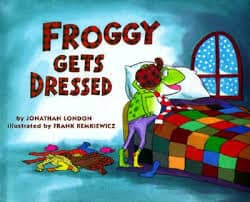
Pattern books are the easiest to teach - best known - easiest to find books around. Scenes, characters, and phrases are repeated with minor variations such as in Froggy Gets Dressed or The Three Little Pigs.
Pattern Books are great for therapy because:
They can be easily used to teach and practice story retelling skills since they follow a predictable pattern and often include a predictable sequence
They include a pattern and new vocabulary words that often repeat, which can be helpful for targeting both semantic and phonological/articulation goals
They often make use of a familiar tone/inflection that kids can chant along to which can facilitate working on phonological and articulation skills – this is built-in repetition of target sounds and words – while still being fun!
They are great books for using cloze procedures to further engage children in the story and teach new vocabulary, as the pattern repeats, (i.e., Froggy put on his_______)
They generally revolve around a theme or category that can be used to tie in with grade level curriculum and expand children’s knowledge of basic concepts
Froggy Gets Dressed/Froggy Se Viste By Jonathan London
How to Use Pattern Books in Speech Therapy
As an example, here is one of our favorite pattern books, and how we like to use it in therapy to target a variety of goals:
Macrostructure- story elements, structure, organization of a narrative
Sequencing, Story elements (characters, setting [time and place], problem, solution, initiating event, character intentions and desires, moral)
Sequencing, Story elements (characters, setting [time and place], problem, solution, initiating event, character intentions and desires, moral)
The benefits of using pattern books to teach vocabulary
When we say that patterns tell stories, from a speech therapy standpoint this can be extremely helpful in reviewing familiar vocabulary and/or teaching new vocabulary. Like many predictable books, the same theme-based vocabulary will be repeated throughout the book. This gives children multiple opportunities to hear the words, repeat them and increase their understanding of new terms when used in different contexts within the book. This can be a great way to work on articulation and phonological targets and syntax and semantic goals as well.
To further cement their knowledge and use of desired vocabulary, using visuals from the books, we can create many of our own pre- and post-story activities to increase children’s engagement with the material, and keep our lessons motivating and entertaining for little ones.
Below are a few ways we love to use a book to expand one lesson into many – and thus develop a mini-unit based around one story:
Review and pre-teach new vocabulary using cards with visuals and/or including a surprise bag for smaller ones (i.e., have children guess what’s inside the bag, then label and discuss items)
Have children draw their own visual for the story and label new vocabulary and practice target words – with Froggy Gets Dressed children can draw themselves and label what they are wearing that day
While presenting the story, we can use visuals from the book to enable kids to have a more active role in the story-telling process (i.e., puppets for characters, each one assigned to a child in group)
Create a game board with story visuals to work on articulation target words or wh- questions as a post-story activity
Have students act out the story to work on their sequencing skills and use of temporal and sequential words
One of our favorite, simple but effective, visuals for Froggy Gets Dressed can be seen below. Children go through the sequence of events during or after the story has been told, and absolutely love helping Froggy get dressed to go play in the snow.
Great Books for Speech Therapy that Use Pattern Books
Below, you will also find a list of some of our other favorite pattern books. Some can only be found in English at this time, but they are books that we commonly translate into Spanish and have basic enough vocabulary that it is easy to do on the fly. We have also included direct links to purchase your favorites through Amazon. We would love to hear from you on how YOU use these books in therapy!
English
Spanish
Description of Story
The Three Little Pigs
Los Tres Cerditos
Bilingual Book
Plot: The classic tale of three pigs who build their houses and encounter a troublesome wolf.
Why we like it: This bilingual version has both English and Spanish on each page and makes use of rhythm and rhyming. This story is great for working on sequencing and retelling, along with providing many articulation targets in both English and Spanish (/r/, /s/, /l/, /d/, /th/).
The Three Bears
Los Tres Osos
Plot: Classic story of Goldilocks' misadventures exploring the three bears’ home.
Why we like it: Using a story that many children are often familiar with can provide them with confidence in targeting retell skills. It also provides ample opportunities for language targets such as family members, size, object/function as well as expected behaviors.
The Three Billy Goats Gruff
Los Tres Chivitos
Bilingual Book
Plot: Three billy goats attempt to cross a bridge and outsmart a troublesome troll.
Why we like it: Another classic story that children may be familiar with provides opportunities for describing, comparing, contrasting and working on sequencing and story retelling skills.
The Carrot Seed
La Semilla de zanahoria
Plot: A little boy plants a carrot seed and faithfully cares for it and waits for it to grow, teaching patience to children.
Why we like it: Although this story is very simple, younger children can enjoy it for learning members of the family, steps to planting a seed, and labeling action words. This book can also serve as an introduction to teaching vegetables as well as targeting /r/ clusters in Spanish.
The Little Red Hen
La Gallinita Roja
Plot: The story of a hardworking hen raises her wheat and bakes her bread while her neighbors idle by.
Why we like it: This is a nice version of a story with rhythm that children can chant to or fill in the blanks. Language targets include action words, labeling nouns, intro to planting/harvesting, and sequencing.
The Gingerbread Man
El Hombre De Jengibre
Plot: A gingerbread man escapes from the oven and tries to outrun all those who may catch him.
Why we like it: Another story that can be ‘sung’ or chanted, this is a great book for targeting initial /r/ in English and trill /rr/ in Spanish along with sequecing and prediction making skills.
The Runaway Bunny
El Conejito Andarin
Plot: A bunny tells his mother he is going to run away and she lovingly describes how she will catch him.
Why we like it: From the same author and illustrator as Goodnight Moon, this story provides children with opportunities for labeling nouns (animals and places) and action words, describing, making predictions, and retelling a story with a structure and rhythm.
Seven Blind Mice
Siete Ratones Ciegos
Plot: A band of blind mice discover something near their pond and venture out to make guesses as to what it could be.
Why we like it: This story is wonderful for practicing describing attributes, size, color, shape and guiding children in making predictions. They will be excited to find out what the creature is at the end of the story and whether their guesses matched up.
Goodnight Moon
Buenas Noches Luna
Plot: A classic bedtime story with goodnight wishes from a sleepy rabbit.
Why we like it: A soothing story for bedtime or a classroom routine (before naptime story), excellent for labeling, describing, increasing vocabulary and targeting 2-3 word phrases.
Want to Get More Out of Your Speech Therapy? - Use Predictable Books
There are eight different types of predictable books as well as ways to use all the different types of predictable books with games. We can use these eight groups to categorize the books we read and get a better understanding of what each book has to offer. These predictable categories also enable us to better define WHY our favorite books for speech therapy are successful, thus helping identify other book titles for future sessions. Click on each story type to read more about each type of predictable books.
Familiar Sequence Story: A common, recognizable theme such as the days of the week, the months, etc. Example: Today is Monday
Chain or Circular Story:The story's ending leads back to the beginning. Example: Where the Wild Things Are
Cumulative Story:The story builds on a pattern. It starts with one person, place, thing, or event. Each time a new person, place, thing, or event is shown, all the previous ones are repeated. Example: There was an Old Lady Who Swallowed a Fly
Question and Answer Book:A question is repeated throughout the story. Example: Brown Bear, Brown Bear
Rhyme Book: A rhyme, refrain, or rhythm is repeated throughout the story. Example: Chicka Chicka Boom Boom
Song Book: Familiar songs with repeated phrases, sentences, rhymes, or refrains. Example: Five Little Monkeys
Pattern Story:The scenes or episodes are repeated with a variation. Example: Froggy Gets Dressed
Note that predictable themes are easier to identify with books written for younger children. We often see more overlap of characteristics in different types of predictable books in stories written for older children, as they contain more story elements.
And if you want to earn CEUs and learn how to effectively learn how to use storybooks in intervention and make games, check out the Literacy-Based Everything Pack
Vice President, Bilingual Speech Language Pathologist
Scott is the Vice President of Bilinguistics and a dedicated bilingual speech-language pathologist based in Austin, Texas. Since 2004, Scott has been passionately serving bilingual children in both school and clinical settings, with a special focus on early childhood intervention.







 Share
Share
 Tweet
Tweet
 LinkedIn
 Pin
Pin
 Email
Email

