


Most speech language pathologists know what ordinary fatigue feels like. It follows a long day of therapy sessions, meetings, and documentation. A good night of sleep, a quiet weekend, or a school break restores clarity. You return feeling capable again.
Burnout feels different.
Burnout is the experience of being physically present but cognitively depleted. Tasks that once required effort now feel disproportionately heavy. Decisions that were once routine demand extended deliberation. You may notice reduced patience in meetings, avoidance of large reports, or difficulty sustaining attention during documentation.
What is especially confusing is that you still care deeply about your work. The students matter. The families matter. The profession still matters.
And yet something feels strained.
Understanding burnout through the lens of executive function helps explain why rest alone sometimes does not fully resolve it. It also gives us the keys to getting back to a place where the job feels manageable and does not take much of a cognitive and physical toll. If you are just arriving here, this is essay two in a series on burnout. You can start at the beginning of the series here: What Executive Function Reveals about SLP Burnout
Burnout as an Executive Access Problem
Burnout is often described emotionally, using words such as exhaustion, cynicism, and inefficacy. While those descriptors are valid, they do not fully capture the cognitive dimension of what is occurring.
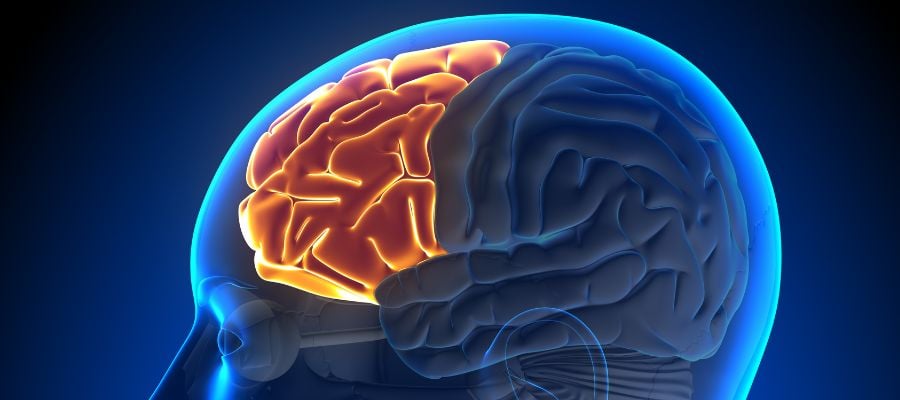
When chronic stress persists, the brain gradually reduces neurochemical support to the prefrontal cortex. As we discussed in the previous article, that region governs planning, inhibition, working memory, and emotional regulation. When access to that system narrows over time, the professional consequences become noticeable.
Throughout our day this can look like:
- Delayed initiation of large tasks like writing a report
- Increased reliance on reactive decision making like working on a teacher's anxious concern which means you pick up your next group late
- Reduced cognitive flexibility in complex situations like pausing standardized testing to complete a quick dynamic task to give you a fuller picture of abilities
- Greater emotional fatigue during conflict like when faced with behavioral struggles
- Prolonged rumination after difficult conversations like telling a parent about their child's progress that you didn't do concisely
Importantly, none of these symptoms indicate a loss of intelligence or training. They indicate restricted executive bandwidth. Additionally, for SLPs working in environments characterized by rapid change, continuous communication, and increasing documentation, this pattern is understandable.
Just like with our clients who have executive function difficulties, we can provide support for the front of our brain by coming up with strategies for remembering, initiating a task, finishing a task, and organization. This can take a bit of the load off and enable us to do our jobs more effectively again.
This needs to be repeated in a variety of ways. There are times of the year where we don't need help remembering things. We don't need to write things down. We don't need to look at a schedule to figure out which students are to be picked up next. But each of these tiny decisions takes a little bit of energy. In a normal day, no big deal.
When things get crazy, using the same charts, schedules, cues, and timers we use with executive function clients can give our brains the freedom to assess what is taking place in front of us without getting bogged down. More on these strategies in essay four.

Why Vacations Sometimes Fall Short
Has this ever happened to you? A break from work produces physical relief. Sleep improves. Emotional tone stabilizes. However, upon returning to work, the same cognitive friction reappears quickly. You try so hard to carry those oh-so-good feelings from vacation back into the job with you! Your intentions are great, but hard to maintain.
This occurs because burnout is not solely about energy expenditure. It is about sustained cognitive load without sufficient structural support.
If the underlying environment remains high velocity, the brain returns to the same adaptation pattern. The prefrontal cortex again narrows access under persistent demand. Without structural changes in workflow or cognitive management, recovery remains temporary.
Does this mean vacations are ineffective? No, recovery time is essential and fun to look forward to. What it means is if you return to work and things aren't better, there is something about the work that needs to change.
I think all of us have had this go two ways: Sometimes you go on a holiday or summer break and when you get back, things are truly better. In these cases, you just needed a break. Other times, you get back and the pace or frenzy of work overtakes you like you had never been gone. Worse! Sometimes the work build-up makes your return even more difficult.
Being scientists (C "S" D), it's easy to see in the second situation that we have ruled out the influence of our own personal and emotional state on why our jobs are difficult. We are typically pretty healthy and happy after a vacation. If we are categorically more relaxed and happy but the job remains the same, something about how the job is being managed needs to change. We can improve this with deliberate management of executive demands.
The Mismatch Between Demand and Recovery
One way to conceptualize burnout is as a mismatch between demand velocity and recovery cycles. Speech language pathologists routinely operate under:
- High decision density
- Frequent task switching
- Emotional labor in family interactions
- Administrative precision requirements
- Continuous digital communication
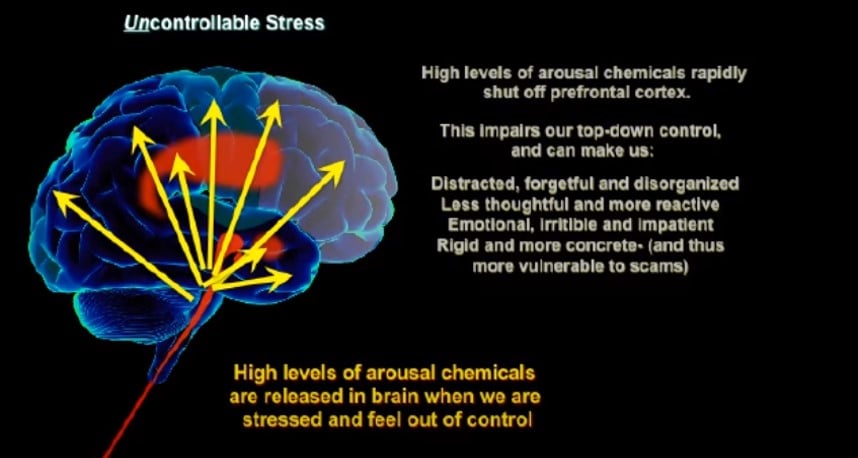
When these demands accumulate without adequate cognitive boundaries, the brain compensates by conserving executive resources. That conservation feels like reduced clarity, slower initiation, and heightened reactivity. This is not theorical! When high levels of arousal chemicals (e.g. stress) are released into the brain, the body defunds the frontal cortex to provide the reactive part of the brain with the energy it needs.
The solution is not to eliminate demand entirely. That is unrealistic in professional settings. The solution is to adjust how demands are sequenced, structured, and buffered.
Other high stakes professions recognize this principle. Surgeons build recovery periods between cases. Military leaders use structured debriefing. Executives employ strict scheduling blocks to protect high level thinking time. And SLPs use...???
These strategies are not indulgent. They are protective.
Check out this cool brain scan image from Futurity.org. In normal people, the brain diverts chemicals, oxygen, and blood flow from the frontal lobe to responsive parts of the brain. That's where our executive functions live and that's we why struggle to engage them.
Why “Try Harder” Backfires
A common response to burnout is internal pressure. Work harder. Push through. Stay later. Respond faster. Ironically, this approach can intensify the problem.
When executive bandwidth is already narrowed, increasing demand without increasing structure further strains the system. Initiation becomes harder. Frustration increases. We can begin to doubt our own competence.
This is why burnout can feel personal.
Understanding that access to the front of the brain and how our secretary-like organization abilities fluctuate under chronic load allows for a more rational response. Instead of asking, “Why can I not handle this anymore?” we ask, “What structural supports does my executive system require under these conditions?”
That is a very different question.
Let's talk about some one-time situations that might make more sense. This part goes out to the new parents and SLPs helping their own parents through health changes, life altering injuries, or health scares. We are not "all there" when faced with a major life event or crisis. Our employment systems understand this and respond through family leave, maternity leave, medical short-term disability, or temporary reductions in service to part-time.
But what do we do for the long-term chronic stress that comes from daily difficulties? This requires help, but our employment systems will not be saving the day in this case. It's on us to implement strategies that keep our wellness a priority.
The Encouraging Reality of Neuroplasticity
The hopeful dimension of executive function science is neuroplasticity. The brain is not static. Executive access can be strengthened through intentional structure and habit formation.
Research demonstrates that executive systems respond well to:
- Clear task capture systems
- Reduced context switching
- Defined cognitive work blocks
- Scheduled recovery intervals
- Consistent routines
These are not abstract productivity techniques. They are mechanisms for restoring executive access.
For SLPs, this means that professional endurance is not simply about resilience. It is about design. When workflow aligns with cognitive architecture, clarity improves. Hopefully by this point you are getting excited! We have proven that executive function strategies help children who need support to access the front of their brains. We can simply apply these supports to ourselves.
Reframing the Experience of Burnout
Burnout does not signify a failed career choice, SLPs. You are not worse at your job than you used to be. It signals that the environment has shifted and your executive system requires new supports.
The conversation moves from, “What is wrong with me?” to, “How do I structure my work to protect my cognitive resources?”
That shift is empowering.
Read On
In the next article, we will examine how other high-stakes professions intentionally protect executive capacity. We will explore practical models drawn from business, medicine, and leadership, and consider how those principles apply specifically to speech language pathologists.
Understanding the brain provides explanation. Learning from structured professions provides tools. And tools are where endurance begins.
A Brain-Based Approach to Increase Success and Satisfaction in Your Work Life
If you would like to earn ASHA CEUs and hear the entire story which includes solutions to address increases in our workload, I recorded a presentation that was part of a keynote address.


 Share
Share
 Tweet
Tweet
 LinkedIn
 Pin
Pin
 Email
Email

