
Picture this: you’re in the middle of a packed week and you get that question again about an articulation disorder:
“What age should they have /r/?”
“Is this articulation or phonology?”
“Can you give me a simple chart for parents?”
“What do I write for the IEP so it actually makes sense to the team?”
None of this is new. It’s just the most common set of speech sound disorder questions we answer on repeat, and the same bits of information we’re always searching for, screenshotting, or rewriting in an email to a teacher. So we pulled it together in one place, in a format you can actually use: clear definitions, clean comparisons, and ready-to-share charts and examples.
The gentle craft is explaining in layman's terms that an articulation disorder is speech-sound production difficulty in which a child cannot correctly pronounce specific phonemes due to motor/articulatory issues rather than phonological pattern errors.
That's a mouthful and why the information in this essay is so important. Below you’ll find:
- What an articulation disorder is (and what it is not)
- How it differs from phonological patterns and motor speech needs
- A quick comparison table you can reference in meetings
- Age norms and common error examples you can share with parents and teachers
- A concise overview of causes/risk factors (without diving back into the textbooks)
- FAQs you can copy into an email or bring to an eligibility conversation
- Practical carry-over and therapy ideas for the classroom and home
Let’s dive in.
What is an Articulation Disorder?
An articulation disorder refers to the difficulty (or inability) to correctly produce one or more individual speech sounds (phonemes), often due to errors in placement, timing, pressure, or movement of the lips, tongue, or other articulators. The root cause is often motoric/articulatory rather than purely linguistic. In other words, the student struggles to physically shape the sound in the correct way.
According to the American Speech‑Language‑Hearing Association (ASHA), speech-sound disorders (SSD) include both articulation and phonological disorders; articulation covers “motor production of speech sounds” among children ages ~3-21.
How It Differs from Typical Development, Phonological Difficulties, and Motor Difficulties
Children acquire speech sounds gradually and by age 5-6, many typical consonants are in place. When a child continues to mis-produce sounds expected for their age (e.g., /r/, /s/, /l/) and it impacts intelligibility in the classroom, that raises a red flag. Unlike a phonological disorder which reflects rule-based error patterns, a pure articulation disorder is about physical production of specific sounds.
Articulation vs Phonological Disorder vs Motor-Speech Disorders
| Disorder Type | Primary Feature | Error Pattern | School-Based SLP Focus |
| Articulation Disorder | Motor/articulatory placement issues | Substitutions (e.g., “wabbit” for “rabbit”), omissions, distortions | Target specific phonemes; placement drills; individual/group therapy |
| Phonological Disorder | Linguistic/phonemic rule-based errors | Pattern errors (e.g., final consonant deletion: “ca” for “cat”) | Focus on sound-pattern rules, minimal pairs, generalization |
| Motor Speech Disorder (e.g., apraxia of speech, dysarthria) | Neuromotor planning/coordination impairment | Inconsistent errors, prosody issues, slower rate | Motor planning/strengthening; close collaboration with OT/PT |
Why the Distinction Matters for School Professionals
For a school-based SLP, accurate classification matters for caseload management, IEP goal-writing, therapy planning, and monitoring progress. If you misidentify an articulation disorder vs phonological disorder, you might choose sub-optimal therapy targets and slow student progress. Or you might treat the student in a group when they need more individualized drills. By knowing which “bucket” a student’s error patterns fall into, you can better align your intervention, documentation, and communication with teachers and families.
Most School SLPs have this down but if you want to learn more or shore up your skills we offer a fun course on it: Success with Speech Sound Disorders.
Age Norms & Common Misarticulation Examples
Sharing the growth of sounds in images and charts is one of the easiest way to show parents and teachers where their child is with their development. Here's a beautiful poster that McLeod and colleagues designed that is free to download.
McLeod, Sharynne, and Kathryn Crowe. “Children’s consonant acquisition in 27 languages: A cross-linguistic review.” American journal of speech-language pathology 27.4 (2018): 1546-1571.
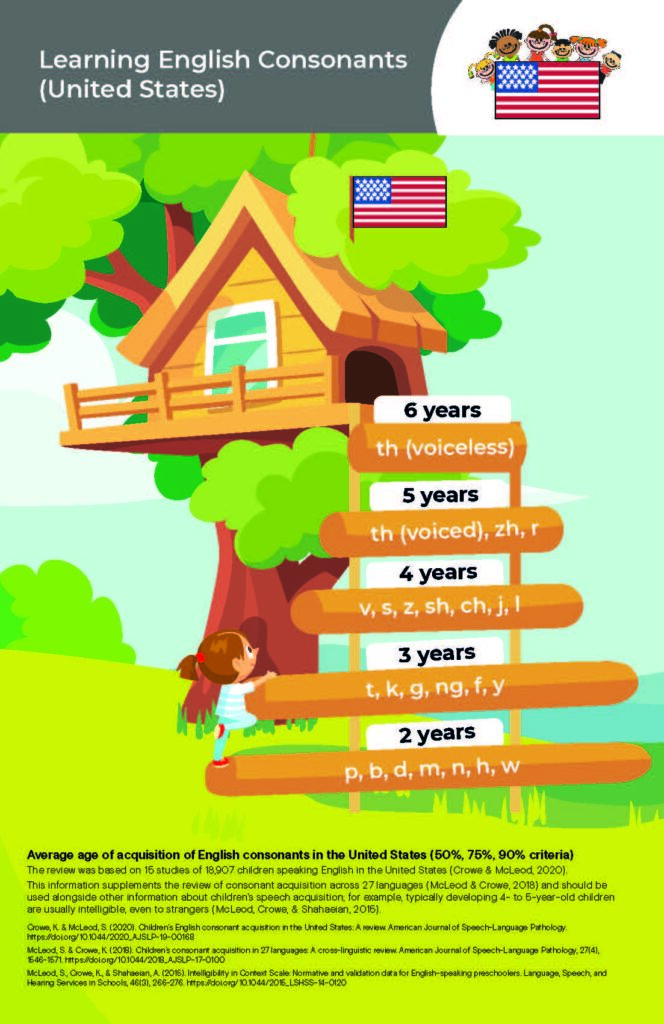
Here’s a simplified table for quick reference table showing some common articulation disorder examples and what they sound like. I am a big fan of this style of information because it plants the seed that this is common, the student or child is not alone, and we are here to help. Also, make sure that your charts have the sounds in them next to the IPA symbols if you are sharing them with non-SLPs!
| Sound | Expected Mastery by Age* | Common Example Error |
| /p, b, m, d/ | ~2 years | Minor error is typical (“puck” for “duck”) |
| /n, h, w/ | ~2 years | "mest" for "nest" |
| /t, k, g, ng, f, y/ | ~3 years | “tat” for “cat” |
| /s, z, ʃ (sh), tʃ (ch)/ | ~4 years | “tair” for “chair” |
| /v, j, l/ | ~4years | “yook” for “look” |
| /ð (voiced th), zh (dge), r/ | ~5 years | “wed” for “red” |
| /θ (voiceless th)/ | ~6 years | “fink” for “think” |
*Note: These are approximate averages; individual and dialectal variation applies.
Typical Articulation Error Types – Substitution, Omission, Distortion
- Substitution: One sound replaced with another (e.g., /w/ for /r/ → “wabbit” for “rabbit”) (ASHA)
- Omission: A sound is left out (e.g., “ta” for “tap”)
- Distortion: Sound produced incorrectly but close (e.g., lateralized /s/ “shlip” for “slip”)
- Addition: Extra sound added (less common in pure articulation)
When you see these errors beyond age-expectancy—and they affect intelligibility or classroom participation—this is the moment to act.

Explaining the Underlying Causes and Risk Factors
After a parent or teacher understands that their child or student is misarticulating, it's natural to question why this is happening. It's a hard position to be in as a professional because the truth is that we don't always know. It can be structural, muscular, sensory-related, affected by hearing development, or simply a matter of a child's specific development. This inexactitude is not very reassuring!
What's important to share is that we have seen this before, the field has been treating this for decades, and the probability of improvement is enormous. Specifically, here is a concise explanation of the underlying causes so that we don't need to dive back into our textbooks:
Structural / Oral-Motor Contributors
Structural anomalies like cleft palate, dental malocclusion, tongue-tie (ankyloglossia), or other orofacial issues can impede accurate articulation. These require collaboration with audiology/ENT or dentistry—as well as your SLP intervention plan.
Sensory / Hearing Factors
Children with recurrent middle-ear infections (otitis media) or hearing loss often mis-perceive specific sounds, which affects production. ASHA reports hearing issues as a risk factor in idiopathic SSDs. (ASHA)
Functional / Idiopathic & Other Risk Factors
Many children with articulation disorders fall into the “idiopathic” category—no known underlying cause. Research shows prevalence of idiopathic SSDs ranges broadly (2.1%–23% in 4-6 yr olds) and that boys are more often affected (~2:1 ratio) in primary grades. (ASHA - articulation disorder ICD 10)
Other risk factors include:
- Family history of SSD or language impairment
- Preterm birth, low birth-weight, perinatal complications
- Lower socioeconomic status (in some studies)
- Co-occurring language, literacy or phonological awareness deficits (important for school SLPs to monitor)
Commonly Asked Questions by Parents and Teachers
When should a child be referred for articulation disorder screening?
A child should be referred for screening when one or more of the following occur:
- They continue to mis-produce age-expected sounds (e.g., /s/, /r/) beyond the norm for their grade or peer group.
- Their speech intelligibility is inconsistent or difficult for peers/teachers to understand.
- Teachers and/or parents report multiple mis-pronunciations that interfere with classroom participation (reading aloud, group responses).
- During universal screening or classroom observation you note repeated substitution, omission or distortion errors that are beyond typical developmental patterns.
Early identification matters because speech sound errors have been associated with literacy and peer/social impact. (ASHA)
Can an articulation disorder resolve without therapy?
Possibly—but as a general rule, if a child continues to produce specific mis-pronounced sounds after the expected age of acquisition, and this impacts intelligibility or participation, waiting passively is not recommended. Some children may “catch up” with time, but residual errors often persist and can affect peer relationships, reading/spelling, and self-esteem. One study found that persistent SSD in 8-year-olds was linked with literacy issues. (ASHA)
In short: if the articulation error persists and is educationally relevant, therapy intervention is warranted rather than assuming spontaneous resolution.
How do I differentiate articulation vs phonological disorders in my caseload?
Key questions to ask:
- Are the errors limited to a small number of phonemes (suggesting articulation) or multiple classes/patterns (suggesting phonology)?
- Do the errors reflect motor placement issues (articulation) or rule-based errors/patterns (phonology)?
- Is the child stimulable for the sound(s)? Can they produce them with cues (common in articulation) or is the pattern entrenched (common in phonology)?
- Is intelligibility the primary issue (articulation) or is the error pattern affecting many words and phonemes, possibly affecting literacy (phonology)?
Use standardized tests, phonetic inventories, and error-pattern analysis. If in doubt (especially older children with inconsistent errors) consider motor-speech disorder referral.
What carry-over strategies work best for older elementary students?
For older students (grades 4–6 and beyond), carry-over must feel relevant and meaningful. Try:
- Embedding targets into oral presentations, class discussion, group work (e.g., student picks a target word list relevant to their science/social studies project).
- Peer-led “speech-buddy” check-in: student and a classmate listen for target sounds and prompt reminders during conversations.
- Self-monitoring checklists: student tracks their own mis-productions during daily tasks and sets “correction-goals” (e.g., correct /r/ in every 3rd sentence today).
- Classroom visuals: discreet cue cards or posters the student can glance at during talk time.
- Home/tech practice: short video or app micro-practice (5 minutes) with weekly teacher check-in to maintain motivation and consistency.
These strategies help the student take ownership of their progress, rather than relying solely on pull-out therapy.
Helping Parents and Teachers Help Their Students
You made it! While the information above is always needed and interesting, it is not necessarily that fun! Let's conclude with some solid ideas for those go-above-and-beyond parents and teachers who want to incorporate what you shared into their day and classroom. Remember: remind them that they will best help the child if they are having fun.
11 Great Articulation Therapy Ideas
- Going on a Sound Hunt: Put artic cards upside down on the floor. Get a flashlight and start searching!
- Cooperative Drawing: Draw or have the child draw one part of an animal, house, or thematic item (ex. school bus, pumpkin, etc.) every time a child practices their sound.
- Puzzles: Put a puzzle piece in when child practices his or her sound.
- I Spy: Go on a scavenger hunt around school and look for objects with the child’s sound.
- Grab bag: Create a grab bag with objects with the child’s sound
- Read a book: Have child practice target phoneme while you read. Have them practice the sound 5, 10, or a ‘bonus’ 15 or 20 times to get the maximum number of trials in during the therapy session. Predictable Books to Improve Speech Skills
- Draw from a book: Have child draw items from the book that begin with the target sound.
- Dice: Roll dice and have the child practice the target word for the number they rolled.
- Make matching cards: Print out 2 copies of artic worksheet. Have child practice target sound, color the pictures, and glue them on construction paper. Voila! You have made matching cards!
- Sensory bin: Search for artic cards in sensory bin filled with rice, beans, or shredded paper.
- Play pretend: Have the child practice their target sound while pretending to be a Ninja Turtle, Transformer, or Elmo. This activity is useful when a child is nervous to practice his or her speech sound.
References
- American Speech-Language-Hearing Association. “Speech Sound Disorders: Articulation and Phonology.” ASHA Practice Portal, n.d., https://www.asha.org/practice-portal/clinical-topics/articulation-and-phonology/.
- Cabbage, Kelly L., and Elise R. Hitchcock. “Treatment Approach Considerations for Children With Speech Sound Disorders.” Language, Speech, and Hearing Services in Schools, vol. 51, no. 3, 2020, pp. 460-472.
- Hitchcock, Elise R., and Kelly L. Cabbage. “Social, Emotional, and Academic Impact of Residual Speech Sound Errors.” Journal of Speech, Language, and Hearing Research, vol. 58, no. 3, 2015, pp. 809-819.


 Share
Share
 Tweet
Tweet
 LinkedIn
 Pin
Pin
 Email
Email