
I've spent a lot of time revisiting my interactions with teachers these days. Not just the recent ones, but even the ones that happened a while ago and are stuck in my memory because I wasn't being as helpful as I wanted or wasn't giving the teacher what they were asking for. In light of this, we have been reshaping much of the lingo that SLPs use on a daily basis so that it also makes sense to both the general education staff and parents. This came out of an epiphany that I had when reframing how SLPs describe phonological awareness and find the same thing to be true when we are trying to describe unintelligible speech.
There are several common questions that are repeatedly asked so we wanted to create a place to bookmark and refer back to that has all the answers laid out in plain English. So let's define unintelligible, explain what unintelligible speech looks like in school settings, outline common causes, and share in simple terms how SLPs assess and treat it, including when the issue is developmental, linguistic, or disordered.

Consider the following scenario: A student responds to a question during a classroom discussion. The teacher walks over, looks on their desk seeking clues to help them understand what the child said. A peer shrugs. The student repeats the message, louder this time, but the meaning is still lost.
When speech is unintelligible, communication breaks down fast and has academic, social, and emotional implications. That's why it is the most common and misunderstood referral concern that SLPs see.
As a general rule, unintelligible speech refers to spoken language that cannot be understood by a listener, either partially or completely, because the speech signal lacks sufficient clarity, accuracy, or organization.
Unintelligible means not able to be understood.
In communication, something is unintelligible when the listener cannot reliably recover the speaker’s message, even when attention, effort, and context are provided.
Unintelligible speech occurs when:
- Words are produced inaccurately
- Sound patterns obscure meaning
- Speech rate, sequencing, or motor planning interferes
- The listener cannot decode what was said without guessing
Importantly, unintelligible does not mean:
- The child is not trying
- The child lacks intelligence
- The child has nothing to say
It means the signal is not clear enough for the listener.
Unintelligible vs. Intelligible: Why the Distinction Matters
Speech exists on a continuum.
- Intelligible speech → most listeners understand the message
- Partially unintelligible speech → familiar listeners understand, unfamiliar listeners struggle
- Unintelligible speech → communication frequently breaks down
SLPs focus on function, not labels. A child may be intelligible to parents but unintelligible to teachers or peers and that distinction matters in schools. This is something SLPs hear all the time and it can lead to a parent or teacher doubting each other. We can help out by explaining the different environments and familiarity of the listeners:
Academic success depends on being understood by unfamiliar listeners in noisy, fast-paced environments.
Unintelligible Speech in Children: What It Looks Like
Unintelligible speech can present in different ways depending on age, language background, and underlying cause. Common characteristics include:
- Frequent sound omissions or substitutions
- Collapsed syllables (e.g., nana for banana)
- Consonant cluster reduction (poon for spoon)
- Inconsistent productions of the same word
- Reduced clarity in connected speech (longer utterances)
- Listener frequently asks for repetition or clarification
Functional Signs in School
- Peers avoid conversation
- Teachers paraphrase or “translate”
- Student stops volunteering answers
- Written work outpaces oral language
- Social withdrawal or frustration
Unintelligibility is not just a speech issue. It's also a participation issue.
What Causes Unintelligible Speech?
Unintelligible speech is a symptom, not a diagnosis. Multiple pathways can lead to reduced intelligibility.
1. Speech Sound Disorders (SSD)
- Phonological disorder
- Articulation disorder
- Mixed articulation–phonological patterns
These are the most common causes in school-aged children.
2. Childhood Apraxia of Speech (CAS)
- Inconsistent errors
- Difficulty sequencing sounds
- Groping or disrupted prosody
Speech may be intelligible in short words but unintelligible in longer utterances.
3. Motor Speech Disorders
- Dysarthria
- Reduced strength, coordination, or tone
Speech may sound slurred, slow, or effortful.
4. Language and Linguistic Factors
- Reduced morphological marking
- Weak phonological representations
- Limited vocabulary leading to circumlocution
5. Multilingual and Dialectal Differences
Language difference does not equal unintelligible speech. However, unfamiliar listeners may perceive speech as unintelligible when:
- Phoneme inventories differ across languages
- Stress or syllable patterns differ
- The listener lacks experience with the speaker’s language or dialect
This is where SLP expertise is essential so we can show how a child should be able to say the sounds that both languages share, but might have difficulty or use different sounds for the ones that are unique to English. The most common sound error in English that occurs due to home-language influence and dialect influence is replacing the "TH" with "D." Teachers naturally understand this exchange of sounds so it is a good example. Then we can introduce sound differences that are unique to the child and her home language.
Unintelligible Speech vs. Accent or Dialect
One of the most common referral errors is confusing unintelligibility with difference. If the message is understandable when the listener knows the linguistic system, the speech is not unintelligible.
| Feature | Unintelligible Speech | Accent / Dialect |
| Meaning recoverable? | Often no | Yes |
| Errors consistent with language system? | No | Yes |
| Affects all listeners? | Often | Usually unfamiliar listeners only |
| Disorder? | Possibly | No |

How Do SLPs Measure Unintelligible Speech?
It's often helpful for SLPs to describe what they are actually doing to assess speech and articulation because in a recent conversation with a teacher I realized that they were looking at it through the lens of how they assess reading. Yes, it is akin to mispronunciations or using the wrong sound. However, with speech testing we dive quite a bit deeper. Here is a collection of our assessment processes.
Percent Words Understood
- Listener transcribes what they hear
- Percentage of words correctly understood is calculated
Unfamiliar Listener Ratings
- Teacher, peer, or unfamiliar adult rates clarity
- More ecologically valid for school settings
Connected Speech Samples
- Story retell
- Classroom explanation
- Narrative or conversation
Key principle: Intelligibility drops as utterance length increases.
Important Context Variables
- Listener familiarity
- Background noise
- Topic predictability
- Visual supports
When Is Speech Considered “Too Unintelligible”?
There is no single cutoff but functional impact guides decisions. General developmental expectations (for unfamiliar listeners, minimal context):
- 2 years: often largely unintelligible when attempting longer utterances but understandable to parents
- 3 years: speech may be partially unintelligible to unfamiliar listeners
- 4 years: speech should intelligible, maybe with some single sound errors
You can see by these ages that if a student’s speech remains frequently unintelligible to teachers or peers, intervention is warranted.
How School-Based SLPs Treat Unintelligible Speech
And lastly, what do SLPs do when we are working to improve intelligibility? I like this following list because SLPs know this stuff perfectly but it is hard to describe what we do to parents and teachers. This list helps me cherry pick ideas that they can be doing to remediate sounds during academic activities or we can give examples for what to do in the home.
Phonological-Based Intervention
- Target patterns that affect many sounds
- Final consonants, clusters, syllable structure
- Improves intelligibility faster than sound-by-sound therapy
Motor Planning Support
- Short, frequent practice
- High repetition
- Visual and tactile cues
Rate and Prosody Work
- Slowing speech
- Chunking phrases
- Increasing stress contrasts
Listener Strategy Training
- Teach peers and teachers to request clarification
- Reduce breakdown frustration
- Encourage repair strategies
Writing Goals for Unintelligible Speech
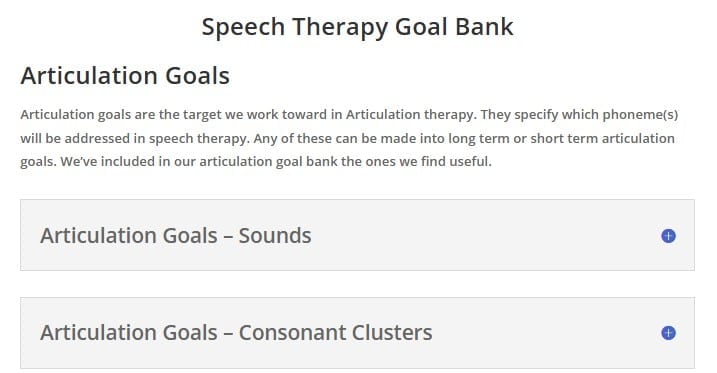
Now for the easy part. We have collected the best articulation and phonology goals in our SLP Goal Bank and have recently digitized it as a free tool inside Evalubox.
Click here to cut and copy the goals: SLP Goal Bank
Click here and scroll down to watch a video about how to easily and digitally create goals: Digital SMART Goals
Commonly Asked Questions About Unintelligibility
u003cstrongu003eWhat does unintelligible mean in speech?u003c/strongu003e
It means the listener cannot understand the spoken message reliably, even when trying.
u003cstrongu003eIs unintelligible speech always a disorder?u003c/strongu003e
No. It may be developmental, linguistic, or related to second-language acquisition.
u003cstrongu003eCan a child be unintelligible to teachers but not parents?u003c/strongu003e
Yes. Familiarity greatly affects intelligibility.
u003cstrongu003eDoes unintelligible speech affect learning?u003c/strongu003e
Yes. It limits participation, assessment accuracy, and peer interaction.
u003cstrongu003eHow do SLPs decide if therapy is needed?u003c/strongu003e
By determining whether unintelligibility negatively impacts educational performance.
Unintelligible speech is not a character flaw, a motivation issue, or a language barrier to ignore. It is a communication access issue and school-based SLPs are uniquely positioned to resolve it.


 Share
Share
 Tweet
Tweet
 LinkedIn
 Pin
Pin
 Email
Email