


Most speech language pathologists do not enter the field thinking about politics. We think about phonology, language development, literacy, swallowing, social communication, and collaboration with families. Yet political decisions are increasingly shaping the decisions we have to make in our daily practice.
When legislation shifts, when refugee policies change, when special education guidance is updated, or when states revise funding priorities, those changes do not remain abstract. They arrive in classrooms, therapy rooms, and IEP meetings.
Political forces are not inherently negative or positive. They are directional. They influence who arrives in our schools, what services are prioritized, how documentation is structured, and how accountability is measured. To understand the current landscape and to identify a force that may contribute to the complexity of our positions, we must acknowledge that policy and practice are closely connected.
If you just arrived here, this is our fourth essay in a series on the changing landscape of the field of speech language pathology. To start at the beginning of this series, click here: Are Speech Language Pathologists Truly Happy With Their Jobs?
Migration Policy and Educational Responsibility
National and state policies regarding immigration and refugee resettlement directly influence school demographics. The United States, for example, has historically accepted substantial numbers of refugees and asylees each year. These families often arrive with remarkable resilience, but also with complex educational histories.
When political decisions expand or contract entry pathways, school districts feel the effect quickly. For speech language pathologists, this may mean:
- Students enrolling midyear with limited educational records
- Increased need for interpreter services
- Heightened sensitivity to trauma-informed practices
- Greater collaboration with social workers and counselors
- Careful differentiation between language acquisition and communication disorder
These responsibilities are not new to our profession. What has changed in recent years is the speed at which demographic patterns can shift in response to policy decisions.
It is important to frame this correctly. The presence of new languages and cultures in our schools reflects longstanding national commitments to opportunity and refuge. Our role is not to evaluate policy; it is to respond competently and compassionately within its outcomes.
As an example, the civil war in Syria and wars in neighboring Iraq dramatically increased the number of Arabic-speaking children in schools across the U.S. In my daughter's elementary school alone, 39 families joined the community in a single autumn. The school had diversity, but watching the curiosity and grace that these children exuded to welcome their new friends was moving.
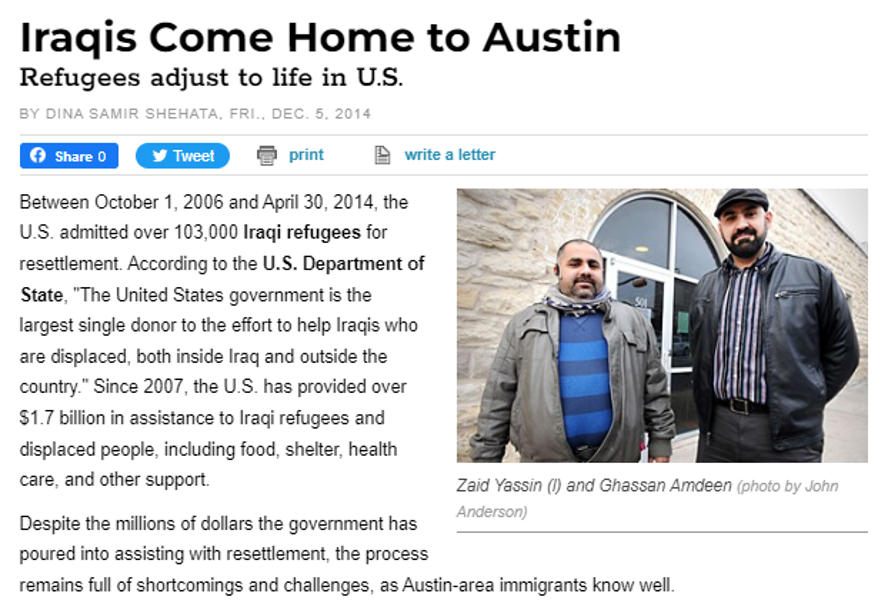
Source: The Austin Chronicle
Was the school positioned to absorb increased enrollment, support the home language, and address the needs that come with displacement? They were educators who, like all of us, rose to the challenge. Was their increase in workload acknowledged? Well...that is kind of the reason for this blog series. The environmental, economic, political, and technological changes that we are facing is not really being addressed.
Added together, the role of the SLP has changed dramatically. By acknowledging how these changes impact our workload, we can seek ways to make the job more manageable.
Special Education Policy and Compliance Expectations
Political decisions also influence how special education is structured and monitored. Changes in accountability measures, funding allocation, and procedural safeguards affect the daily responsibilities of clinicians.
For speech language pathologists, policy changes may translate into:
- Expanded documentation requirements
- Increased emphasis on data collection and progress monitoring
- Revised eligibility criteria or procedural timelines
- Adjustments in Medicaid billing compliance
- Greater scrutiny of evaluation and dismissal decisions
These changes are typically designed to ensure equity and accountability. However, they often increase administrative complexity. When systems prioritize compliance, clinicians must devote cognitive resources not only to intervention but also to documentation precision.
Again, the goal is not to criticize accountability. Accountability protects students. The professional challenge lies in balancing high standards of compliance with sustainable workload expectations.
Public Discourse and Professional Identity
Political climates also shape public discourse around education, diversity, and healthcare. Conversations about bilingualism, inclusion, disability services, and educational funding occur at local, state, and national levels.
Speech language pathologists frequently operate at the intersection of these conversations. For example:
- Bilingualism may be framed as either an asset or a deficit depending on local narratives.
- Inclusion practices may shift based on district leadership priorities.
- Access to services may be debated in broader discussions of educational reform.
In such environments, clinicians must remain grounded in research and ethical practice. Our responsibility is to apply evidence-based principles consistently, regardless of shifting rhetoric.
The positive framing is clear. When public conversations intensify around education and diversity, it underscores the importance of our expertise. Language, communication, and access to services are central to those discussions.
We are not peripheral professionals. We are central contributors to equity and opportunity.
The Emotional Dimension of Policy Change
Political shifts can also influence the emotional climate within schools. When families relocate due to geopolitical events, economic restructuring, or policy decisions, uncertainty may accompany that transition.
Speech language pathologists often encounter this emotional layer indirectly. A student referred for evaluation may present with academic or behavioral concerns that are intertwined with adjustment stress. Families may carry questions about stability, access, and long-term planning.
This does not mean that every referral reflects trauma or systemic change. It means that the social context surrounding communication development has become more layered. These are areas in which our profession has grown substantially over the past decade.
Political forces will continue to shape education and healthcare. That reality is neither new nor temporary. What is notable about the current era is the pace at which policy discussions translate into operational shifts within districts and clinics.
Rather than viewing this as instability, we might consider it a sign of a society actively negotiating how best to serve diverse populations. Education and healthcare are always at the center of that negotiation.
Speech language pathologists are uniquely positioned in this landscape because we:
- Work directly with families across cultural and linguistic backgrounds
- Translate complex developmental information into accessible language
- Advocate for equitable access to services
- Bridge medical, educational, and social domains
In times of policy change, those skills become even more valuable.
Read On
Environmental shifts, economic migration, and political forces all contribute to a rapidly evolving professional landscape. Yet one additional force interacts with all of them: technology.
In the next article, we will explore how technological acceleration has reshaped documentation, communication, compliance, and expectations within speech language pathology.
Understanding technology’s role is essential because it influences not only how we work, but how quickly we are expected to adapt.
Important Summary SLPs!
If you are feeling like our jobs have gotten more difficult to keep up with and more complex you are not alone and your feeling is accurate! Hopefully by now in this series you are seeing that there are multiple-simultaneous sources of pressure and change.
As we move forward, the goal remains the same: to name the forces shaping our profession clearly so that we can respond thoughtfully, sustain our careers, and continue serving at a high level.
A Brain-Based Approach to Increase Success and Satisfaction in Your Work Life
If you would like to earn ASHA CEUs and hear the entire story which includes solutions to address increases in our workload, I recorded a presentation that was part of a keynote address.


 Share
Share
 Tweet
Tweet
 LinkedIn
 Pin
Pin
 Email
Email

