


Across North America, economic growth does not occur evenly. Industries expand in certain regions. Housing markets shift. Energy, manufacturing, agriculture, and technology create pockets of rapid development. When opportunity moves, families move with it.
For speech language pathologists, economic migration rarely makes headlines. Yet it is one of the most powerful forces reshaping our caseloads, our collaboration models, and the diversity of the students we serve. This is not a temporary fluctuation. It is a structural pattern. And it has meaningful implications for our field.
If you just arrived here, this is our third essay in a series on the changing landscape of the field of speech language pathology. We are covering four factors that have been making our jobs more complex. This article is about the economy but to start at the beginning, click here: Are Speech Language Pathologists Truly Happy With Their Jobs?
Defining Economic Migration
Economic migration occurs when individuals or families relocate primarily for employment and financial stability. These moves may be:
- International, such as families entering the United States for work opportunities
- Interstate, as industries expand in specific regions
- Intrastate, when families move from rural to urban centers or vice versa
- Intentional, to take advantage of job opportunities
- Unintentional, to respond to family needs
In recent decades, some regions have experienced extraordinary demographic shifts due to economic growth. States that historically had limited linguistic diversity have seen rapid increases in multilingual populations. Entire communities have been reshaped in a single generation.
Giving a few examples, real estate booms on the East Coast of the US are drawing working populations away from Florida:
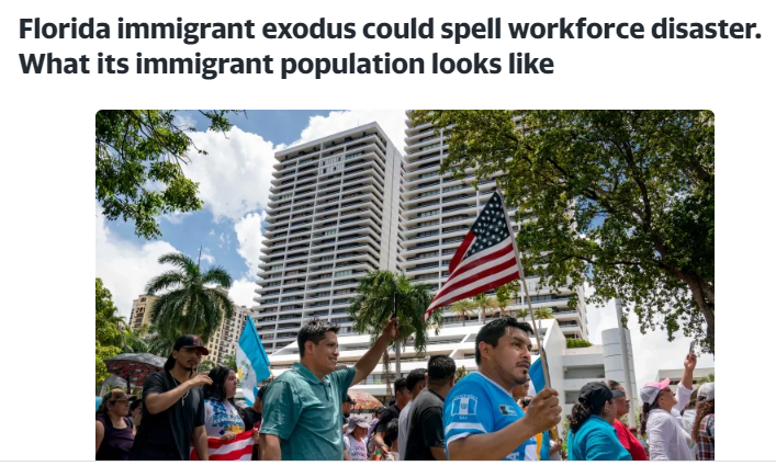
Source: Yahoo News
Fracking has both increased the population and diversity in the Dakotas. McKenzie County in North Dakota experienced a 1002% increase in Hispanic growth between 2010 and 2020.

Source: LatinoUSA.org
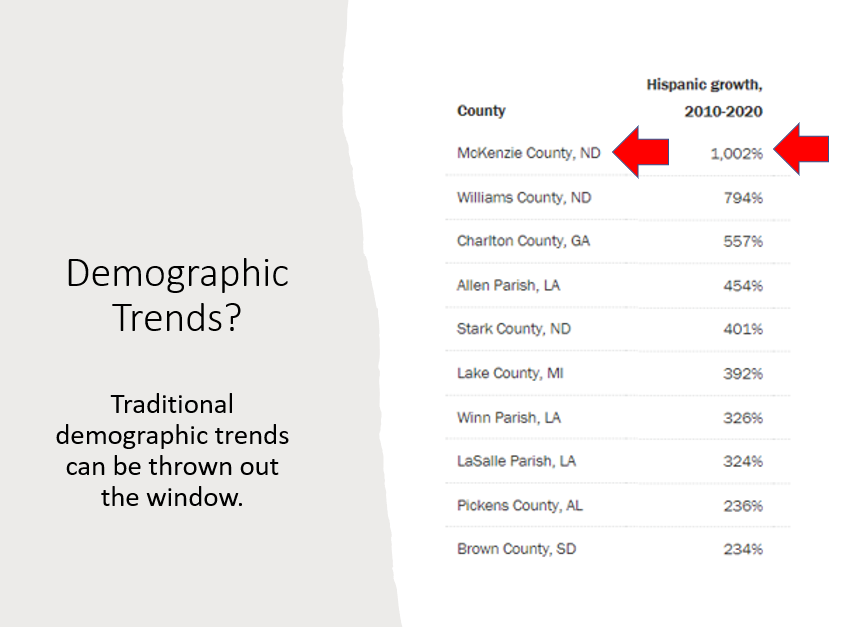
For school systems and healthcare providers, this translates into expanding linguistic and cultural diversity at a pace that often outstrips infrastructure. For speech language pathologists, the impact is immediate and practical.
How Economic Shifts Change Caseloads
When industries grow, communities diversify. When communities diversify, schools change. When schools change, the work of speech language pathologists evolves.
Economic migration affects our daily work in several ways:
- Increased linguistic diversity requiring expanded assessment practices
- Rapid enrollment growth that strains existing staffing models
- Influx of students with interrupted educational histories
- Expanded need for culturally responsive evaluation tools
- Greater collaboration with multilingual staff and interpreters
In some districts, the change has been gradual and supported by evolving policies. In others, growth has been sudden, leaving clinicians to adapt in real time.
It is important to recognize that this complexity does not represent failure within the system. It reflects economic vitality and demographic evolution. However, adaptation requires intentional support and professional development.
Diversity as an Asset, Not a Burden
Economic migration often introduces new languages and cultural perspectives into communities that may not have previously experienced high levels of diversity. For clinicians, this can initially feel daunting. We may encounter languages for which we have limited training or assessment tools.
Yet economic diversity also brings significant strengths:
- Students who are bilingual or multilingual develop cognitive flexibility
- Families often bring strong community networks and resilience
- Schools gain broader cultural perspectives
- Future workforces benefit from linguistic versatility
This is why we built the free SLP World Language Library so that SLPs have the information they need when confronted with new languages.
As speech language pathologists, we are uniquely positioned to bridge language development, educational access, and long-term opportunity. When we accurately distinguish language difference from language disorder, we protect students from inappropriate identification while ensuring access to needed services.
Economic growth may stretch systems, but it also underscores the relevance of our expertise. Again, in line with the message of this series: we are uniquely poised to help in these situations but we need to extend ourselves some grace if we live in these communities and also feel overwhelmed by the rate of change.
The SLP Reality: Infrastructure Lag
Here's a phrase that never appeared in my CLD textbooks: "Infrastructure Lag." To be honest, I never heard this term before researching this topic, but now cannot find a better phrase to describe our situation.
Infrastructure Lag is the gap in time between when a community or profession identifies a problem and when they receive the materials, support, and resources to address the problem.
I can already hear the veterans among us laughing with me: "There is a time when things catch up?!"
While economic growth can be rapid, educational and healthcare infrastructure typically evolves more slowly. New industries may bring families into a region faster than districts can:
- Hire and train multilingual staff
- Update assessment materials
- Adjust caseload models
- Build culturally responsive frameworks
This lag can increase pressure on clinicians. It may require creative scheduling, expanded consultation, and thoughtful prioritization.
However, acknowledging infrastructure lag does not mean resigning ourselves to frustration. It means recognizing that adaptation takes time and that clinicians are often leading that adaptation at the ground level.
We are not merely reacting to change. We are helping shape how systems respond to it.
A Professional Opportunity
Economic migration reinforces a broader truth about our profession. Speech language pathology sits at the intersection of language, education, healthcare, and social mobility.
When industries expand and communities diversify, access to effective communication becomes even more critical. Students who develop strong language skills are better positioned to:
- Navigate academic demands
- Access higher education
- Participate fully in civic life
- Contribute meaningfully to growing industries
In this sense, economic change amplifies the importance of our work. We are not only serving individual students. We are supporting the communication infrastructure of evolving communities.
That is not a small responsibility. It is also not a small opportunity.
Moving Forward Strategically
Economic migration challenges us to expand our professional toolkit. It invites us to:
- Strengthen cultural and linguistic competence
- Advocate for updated assessment practices
- Collaborate closely with administrators regarding workload realities
- Engage in professional learning that reflects demographic change
Most importantly, it encourages us to view change as structural rather than personal. If your caseload feels more complex than it did ten years ago, that perception is grounded in broader demographic patterns. It is not a reflection of diminished competence or resilience.
Understanding the economic forces shaping our work allows us to respond with intention rather than react with discouragement. Not to sound too Pollyanna-ish but there is one more positive side to this. Economic growth in your area means job security in the health and educational sections. Yes, we are on the ground dealing with this firsthand, but we are also truly needed.
Read On
In the fourth and next article, we will examine political forces that intersect with environmental and economic migration. Policy decisions, refugee resettlement, and shifts in educational legislation all influence the day-to-day experience of speech language pathologists.
By naming these forces clearly, we gain perspective. And perspective allows us to approach our work with steadiness and purpose rather than uncertainty.
The goal of this series is not to dwell on difficulty. It is to understand the landscape so we can continue practicing at a high level with clarity and confidence.
A Brain-Based Approach to Increase Success and Satisfaction in Your Work Life
If you would like to earn ASHA CEUs and hear the entire story which includes solutions to address increases in our workload, I recorded a presentation that was part of a keynote address.


 Share
Share
 Tweet
Tweet
 LinkedIn
 Pin
Pin
 Email
Email

