
During a recent workshop on Success with Speech Sound Disorders we had the distinct and rare pleasure to work with an entire district for an entire day and focus on nothing but sounds. It is uncommon in our hectic schedules to get a full day of professional development on anything, let alone a single subject. But in this case, the team wanted to concentrate completely on articulation and phonological processes to get their students who were hard to understand moving through their goals faster.
The day was going well enough but took a dramatic turn for the better when we pushed pause on what was planned and discussed the difference between articulation and phonology and became crystal clear about what phonological processes were. It's not that they didn't know the difference in general terms but did they know:
- The percentage of their caseload that fell into each camp
- If they were correctly applying phonological goals or articulation goals, or mixing the two
- How a phonological processing disorder comes about compared to articulation
What became apparent was that the concept of intelligibility has many of us lumping articulation and phonological processing together when they are distinct classes that need distinct intervention. I have reproduced what we covered here with some neat downloads and resources. Read on because this article gives you:
- A ready-to-print phonological processes quick-reference chart
- The age norms you refer to when writing IEPs
- Classroom-friendly screening checklists
- Bilingual/multilingual insights
Phonological Processes vs Articulation: Why It's Important
Distinguishing between articulation and phonology is very important. Articulation refers to the physical production of sounds which includes the motor act of shaping airflow and articulators. Phonology involves the rules and patterns that govern sound use in a given language and how one sound can stand in for another, simplify clusters, or alter syllable structures. A child might be able to articulate /k/ and /g/ but still say “tat” for “cat” because the rule of fronting (velar → alveolar) is in place.
By focusing on phonological patterns rather than just isolated sound errors, you address the system of sound use rather than merely correcting individual mis-productions. This may seem pretty straight forward for seasoned SLPs, but the number of SLPs in our session who said they mixed goals and approaches was pretty high. Applying motor-based approaches to a rule problem and vice-versa results in really slow growth if at all.
Typical development vs disorder
Phonological processes are a normal part of children’s speech-sound development. They allow children to simplify complex target words while their articulatory systems and phonemic inventories are still maturing. Many research and clinical sources emphasize that processes like weak syllable deletion, cluster reduction or final consonant deletion should resolve by predetermined age norms. When these processes persist or when children exhibit atypical patterns (e.g., backing, initial consonant deletion) they may reflect a phonological disorder rather than just delay. For example, Cabbage et al. (2020) describe how intervention approaches shifted from individual phonemes to patterns (cognitive–linguistic models) as research clarified that the phonological system needs remediation, not just sounds one at a time.
Understanding this helps school-based SLPs frame both assessment and intervention more systemically.
School-Based SLP Buy-In:
Impact on intelligibility & academic participation
In a school environment, students speak not only for personal communication but for classroom participation, peer interaction, reading aloud, responding to teacher prompts, and social engagement. A student who uses multiple phonological processes may be significantly less intelligible to classmates, may avoid speaking, may struggle with reading aloud, and may participate less or have fewer behavioral responses (“I don’t want to talk because no one understands me”).
Moreover, speech intelligibility is tied to literacy outcomes: children with persistent phonological processes often show weaker phonological awareness and memory, which are linked to reading difficulties. For instance, Tambyraja et al. (2022) found that children with speech sound disorders (SSD) showed poorer phonological awareness and memory, which mediated reading risk.
As the SLP in a school, you become the bridge: linking speech-sound remediation to language, literacy, and academic access.
Collaboration with teachers & IEP relevance
In the school context, your role extends beyond direct therapy. You collaborate with classroom teachers, special educators, reading specialists, and parents. You may need to explain to teachers why a student’s speech-sound system isn’t “just articulation,” why the student keeps making the same errors, and why those errors matter for classroom discourse. In IEPs, you’ll map phonological processes to intelligibility goals, peer interaction, participation, reading readiness or fluency, and carryover across environments.
For example: if a 2nd-grade student still deletes final consonants, you might craft a goal around improved intelligibility in classroom response ("Student will reduce final consonant deletion in connected speech to < 10% error rate in classroom prompts") rather than simply practicing /t/ in isolation. This emphasizes system-change, not just sound change.
Types of Phonological Processes (with Table)
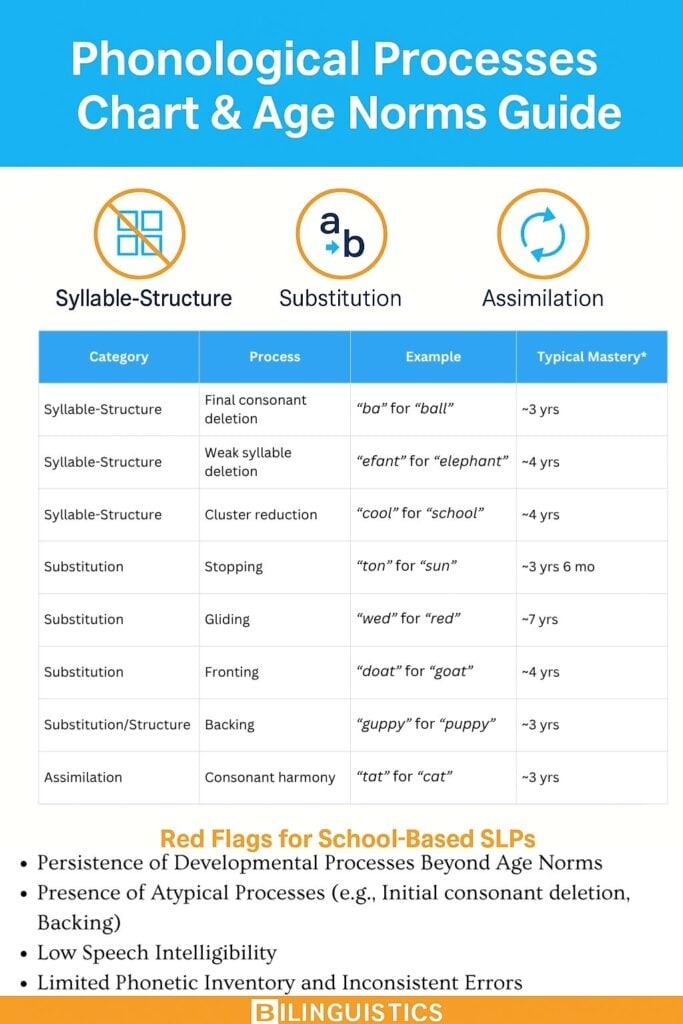
Here’s a handy table you can use in sessions or share with teachers/parents based on Shriberg (1993):
| Category | Process | Example | Typical Out-growth Age* |
|---|---|---|---|
| Syllable-Structure | Final consonant deletion | “ba” for “ball” | ~3 yrs |
| Syllable-Structure | Weak syllable deletion | “efant” for “elephant” | ~4 yrs |
| Syllable-Structure | Cluster reduction | “cool” for “school” | ~4 yrs |
| Substitution | Stopping | “ton” for “sun” | ~3 yrs 6 mo |
| Substitution | Gliding | “wed” for “red” | ~7 yrs |
| Substitution | Fronting | “doat” for “goat” | ~4 yrs |
| Substitution/Structure | Backing | “guppy” for “puppy” | ~3 yrs |
| Assimilation | Consonant harmony | “tat” for “cat” | ~3 yrs |
*Age norms are approximate, based on a synthesis of clinical sources. Always interpret in context of dialect/linguistic background.
Note: Although classic clinical tables vary slightly, many align with the above ranges. Sources such as Khan (1982) and Hodson & Paden (1983) describe ~40% frequency thresholds and typical ages.
As a fun tip: print this as an 8.5×11 chart (see downloadable handout) and laminate for your speech room. We have also created a PDF version: Phonological Processes Chart and Age Norms Guide
Age Norms & Elimination Chart
When to consider a process “resolved” and when to raise a red flag? For school-based SLPs, this is key for screening, referral decisions, and writing service eligibility.
- Many syllable-structure processes (final consonant deletion, weak syllable deletion, cluster reduction) typically resolve by age 4.
- Some substitution processes (gliding, cluster simplification) may persist slightly longer (age 5–6).
- Any process persisting beyond the first half of elementary school (≥8 years) or processes such as backing, initial consonant deletion, glottal replacement, or atypical assimilations are considered red flags.
- Consider intelligibility: even if a process is within a normative age, if intelligibility is impacted (less than ~75% or poor functional communication) then intervention is warranted.
- For bilingual/multilingual students: adjust norms with caution, account for phoneme inventories and dialectal/language background differences.
Referral triggers for school SLPs:
- Presence of an atypical process (e.g., backing) at any age
- Intelligibility < 70% in class peer contexts
- Persistence of ≥ 2-3 processes beyond age norms
- Poor phonological awareness, phonological memory, or rapid naming (see next section)
Remember: intervention decision is about function and access not just hitting elimination ages.
Screening & Assessment in the School Setting for a Phonological Processing Disorder
Quick checklist for school-based SLPs
- Student’s age → are processes still typical for that age?
- Number and type of processes present (more processes = greater risk)
- Intelligibility in spontaneous speech (classroom responses, peer interaction)
- Presence of atypical processes or patterns
- Literacy risk factors: poor phonological awareness, phonological memory, RAN (rapid automatized naming)
- Multilingual/ELL considerations: possible transfer, dialectal features, but also potential co-occurring disorder
Tools & informal probes
Because standardized assessments may not always target phonological processes, you’ll often need quick non-standardized probes. Consider:
- A short connected speech sample (e.g., 50–100 words) and coding for processes via a table
- A quick single‐word list of about 20–25 words with target sounds/clusters; tally % process errors
- Phonological awareness tasks (blending, segmentation) and memory tasks (nonword repetition) to identify deeper phonological-processing issues. Research shows children with SSD are at increased risk of phonological processing deficits which in turn relate to reading risk.
- For bilingual/multilingual children: use tasks in both languages (or language the child is most skilled in) and avoid wrongly attributing typical L1 transfer to a disorder. According to Roepke (2023), “Selecting stimuli aligned with the child’s phoneme inventory in both languages improves validity.”
- Use chance criteria: for instance, if a process occurs in more than 40% of opportunities, it may warrant intervention (Hodson & Paden recommendation).
Include the non-standardized results in your IEP decision-making
Once you’ve screened, you’ll map findings to IEP goals such as:
- “By June 2026, the student will reduce cluster-reduction errors in connected speech from 60% opportunities to 20% opportunities as measured in classroom prompts.”
- “Student will improve intelligibility to peers from ~60% to ≥ 85% in at least three different classroom situations.”
- “Student will increase blending and deletion skills to support phonemic awareness, thereby supporting reading readiness.”
By linking processes → intelligibility → literacy → academic success, you strengthen the rationale for services.
Intervention Strategies & Tips for the Classroom
Therapy approaches: what research supports
Intervention for phonological processes isn’t one-size-fits-all. Moreover, articulation activities will not help much. Instead, here are evidence-informed approaches and school-based practicalities:
- Cycles Approach: Designed for children with multiple phonological processes, and are highly unintelligible. Targets stimulable sounds/patterns in repeated cycles rather than waiting for mastery before moving on. Hodson & Paden’s work emphasizes this for school settings.
- Minimal Pairs / Multiple Oppositions: Use when children collapse phoneme contrasts (for example substituting /k/ and /t/). Minimal pair therapy draws attention to meaning-changing differences and helps restructure the sound system.
- Complexity Approach: For children with severe phonological disorders, selecting complex targets can trigger system-wide change more efficiently. While less common in schools due to time constraints, it may fit pull-out groups or push-in models.
- Integrating Phonological Awareness Interventions: Because phonological processes tie to literacy risk, pair sound-system work with phonemic awareness (blending, segmentation) and phonological memory tasks. Farag et al. (2023) found that phonological awareness training improved speech production outcomes.
Classroom accommodations & teacher-friendly ideas
- Post the quick-ref chart on the speech room wall and share a simplified version with the teacher (e.g., "Student targets final consonants in class responses").
- Use "sound of the day/week" bulletin boards: highlight a process (e.g., cluster reduction) and show how classmates can help listen for long/short words, ask the student to record self-monitoring.
- Use peer-buddy reading: a listening-buddy can help mark when target sound errors occur in spontaneous speech (class response, group work) and provide positive reinforcement.
- Embed goals in academic content: when students are writing or speaking, provide sentence starters or visual cues reminding the student of target processes (e.g., "Don’t delete that final consonant—my friend will understand me!")
- Monitor progress over time: use monthly quick probes in the classroom setting to check carryover, not only in the therapy room.
Bilingual/multilingual students: special considerations
- Distinguish language difference vs phonological disorder: Some processes may be typical transfers from L1 to English (e.g., final consonant deletion for many languages).
- Use dual‐language phoneme inventories: Determine which phonemes/clusters exist in the child’s L1, which are new in English, and whether the error pattern is consistent across languages or only in English.
- Modify assessment: As Roepke (2023) states, tasks should consider the child’s phoneme inventory and responses may be receptive rather than requiring spoken production.
- Consult language/dialect research: Some dialects (e.g., African American English, Spanish-influenced English) include features that resemble phonological processes (like cluster reduction) but are typical for those dialects, not disorders. The key is intelligibility and system impact.
- Collaborate with interpreting or bilingual specialists and include parent/teacher input around cross-language intelligibility, not just English speech.
Red Flags & Referral Triggers
Persistent processes beyond age norms
If you see any of the following, it’s time to increase monitoring or refer for more intensive evaluation:
- A child aged 8 years or older still omitting final consonants or using gliding and cluster reduction as primary processes
- Use of atypical processes such as backing, initial consonant deletion, or glottal replacement—even if younger
- More than one process present, especially ones that interact (e.g., cluster reduction + fronting)
- Intelligibility remains low: for example, peers frequently ask “What did you say?” or teachers interpret answers incorrectly; student avoids talking
- Literacy or reading concerns: Given the link between phonological processing and phonological awareness/reading, persistent processes can be a red flag for risk. Roepke (2023) notes that children with SSD plus phonological processing deficits have higher reading risk.
Co-occurring language/reading difficulties
The teacher's input becomes important when children with phonological processes are also struggling with reading. Don’t view phonological processes in isolation. Consider the broader profile:
- Does the child struggle with phonological awareness (segmenting/blending)?
- Does the child have weak phonological memory (difficulty repeating nonwords) or slow rapid naming? These impact reading fluency and writing.
- Are there language deficits (vocabulary, morphology) that may compound the sound system issues?
- Are there literacy concerns (poor decoding, reading fluency) that align with speech errors? For example, Tambyraja et al. found that children with SSD who also showed phonological awareness deficits were more likely to have reading difficulties.
Referral to the reading specialist or school psychologist may be appropriate when you identify these cross-domain concerns.
Frequently Asked Questions
Is gliding a problem if it persists until age 6?
While gliding may linger into early elementary, if intelligibility is impacted or other processes coexist, intervention is recommended.
How do I know whether a bilingual student is using a phonological process versus a language difference?
Compare the student’s production in both languages, consult research on the L1 phonology, and look for atypical processes (e.g., backing) or persistent patterns beyond norms.
Can I treat phonological processes in a group therapy session at school?
Yes. Small groups of 3–5 children with similar target processes can benefit from cyclic scheduling and minimal pair work, provided you monitor individual progress.
Do phonological processes need to be “gone” before reading instruction begins?
No. But persistent processes may signal risk for phonological awareness difficulties, so coordinate with reading specialists and monitor literacy closely.
What’s a quick way to explain a phonological process to a teacher?
“It’s like the child’s brain has created a shortcut rule for sounds—for example they say ‘tat’ for ‘cat’ because fronting is easier. We’re helping them upgrade that shortcut to match adult-listener rules.”
References
- American Speech-Language-Hearing Association. “Selected Phonological Patterns (Patterns).” ASHA Practice Portal.
- Cabbage, K. L. & DeVeney, S. L. (2020). Treatment approach considerations for children with speech sound disorders in school-based settings. Topics in Language Disorders, 40(4), 312-325.
- Roepke, Elizabeth. “Assessing Phonological Processing in Children With Speech Sound Disorders.” Perspectives of the ASHA Special Interest Groups, vol. X, no. Y, 2023,
- Shriberg, L. D. (1993). Articulation assessment instruments and procedures file. Madison: Waisman Center, University of Wisconsin-Madison.
- Shriberg, L. D., & Kwiatkowski, J. (1993). Speech normalization in developmental phonological disorders: A retrospective study of capability-focus theory. Language, Speech, and Hearing Services in Schools, 24(1), 10-18.
- Shriberg, L. D. (1993). Four new speech and prosody-voice measures for genetics research and other studies. Journal of Speech and Hearing Research, 36(6), 105-121.
- Tambyraja, S. R., et al. “Phonological Processing Skills in Children With Speech Sound Disorders.” Journal of Speech, Language, and Hearing Research, vol. Z, 2023.


 Share
Share
 Tweet
Tweet
 LinkedIn
 Pin
Pin
 Email
Email