
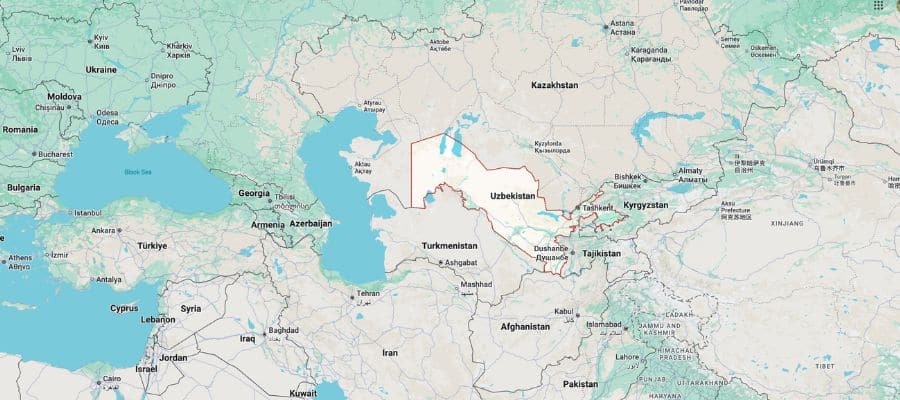
Uzbek is a member of the Turkic family, belonging to the southeastern, or Chagatai, branch of the Turkic languages. Uzbek speech and language development traces back to the Chagatai language that gained prominence during the Timurid Empire. Uzbek has two main dialects: approximately 29 million speakers use the Northern dialect primarily found in Uzbekistan, while nearly 4 million speak the Southern dialect predominantly in Afghanistan and Pakistan. The Turkic languages originated in a region of East Asia spanning from Mongolia to Northwest China, where Proto-Turkic is thought to have been spoken, from where they expanded to Central Asia and farther west during the first millennium. The writing systems of Uzbek features a blend of Latin, Cyrillic, and Perso-Arabic scripts, demonstrating how various influences have shaped this language while keeping it alive and accessible across diverse communities.
Uzbek is not only spoken by people within the territory of Uzbekistan, but also by minority populations in the neighboring Central Asian states, labor migrants in Eastern Europe and East Asia, as well as Uzbek diasporas in these and other regions of the world. It is estimated that there are over 30 million Uzbek speakers in the world. The language is recognized as a minority language in countries including China, Pakistan, Tajikistan, Kazakhstan, Turkmenistan, Kyrgyzstan, and Russia. In the United States, according to the 2019 American Community Survey, around 65,000 Uzbek people are estimated to live in the United States, most concentrated in New York City.
This article informs you on the Uzbek language so you can improve how you work with its speakers.
Interesting Facts About Uzbek Speech and Language Development
- Borrowed words make up over 40% of the Uzbek lexicon, with Russian-origin terms accounting for approximately 26%, demonstrating the language's remarkable adaptability to foreign influences
- In the Xinjiang region of China, some Uzbek speakers write using Cyrillic, others with an alphabet based on the Uyghur Arabic alphabet. Uzbeks of Afghanistan also write the language using Arabic script, showing how geography influences writing systems.
- From the 10th to the 12th century, Uzbek written literature migrated from a Turkic script to an Arabic one. This transition opened Uzbek writers to the influence of Arabic literature, and Uzbek literature underwent extensive changes as it adopted many of the forms of Arabic literary tradition.
Uzbek Speech and Language Development
Uzbek Consonants in Comparison to English
| Uzbek Consonants Not Shared with English | /q/ (uvular stop) /ʁ/ (uvular fricative) /χ/ (voiceless velar/uvular fricative) /ɸ/ (voiceless labial fricative) /ts/* /ʔ/* |
| Consonants Shared With English | /p/ /b/ /t/** /d/** /k/ /g/ /f/ /v/ /s/ /z/ /ʃ/ /tʃ/ /dʒ/ /m/ /n/ /ŋ/ /j/ /l/ /w/ |
| English Consonants Not Shared with Uzbek | //θ/ /ð/ /ɹ/ /h/* /ʒ/* |
*Used in some dialects of Uzbek or in loanwords.
**Produced as dentals /t̪/ /d̪/ in Uzbek.
Uzbek Vowels in Comparison to English
| Uzbek Vowels Not Shared with English | none |
| Vowels Shared With English | /i/* /e/** /æ/ /a/ (or /ɔ/ depending on context) /o/ /u/ |
| English Vowels Not Shared with Uzbek | /ɚ/ /ɪ/ /ʊ/ /ʌ/ /ə/ |
*Sometimes pronounced further back as /ɨ/ in Uzbek.
**Pronounced as ( /ɛ/) in some contexts.
Notes on Uzbek Phonology
- Uzbek’s consonant inventory includes unique uvular and velar fricatives/stops (/q/, /ʁ/, /χ/) absent in English.
- English has interdental fricatives (/θ/, /ð/) and the alveolar approximant /ɹ/ not found in Uzbek.
- Uzbek has six vowels only; English has a richer vowel system including lax, central, reduced, diphthong and rhotic vowels, which Uzbek lacks.
- English /h/ exists in Uzbek only as /h/ but Uzbek /h/ is weaker
The Use of Phonotactic Constraints in Uzbek Speakers
- Word‑initial consonant clusters are heavily restricted
Uzbek typically prohibits consonant clusters at the beginning of words—most syllables begin with a single consonant or a vowel (CV‑) structure (Pedagogs). - Minimal consonant clusters allowed in onsets or codas
When consonant clusters do occur, they are usually limited to simple two‑consonant sequences, often split across syllables (e.g. C V C.C) rather than tightly bound clusters—syllables never begin with two consonants (Global Research Network Journals). - Canonical syllable template is CV(C)
The most common syllable shape in Uzbek is CV or CVC, sometimes followed by a consonant in the coda. Complex codas beyond one consonant are rare (Universal Conference). - Syllable structure prevents CC in both onset and nucleus
Two-consonant sequences are avoided in onsets; if written, they are segmented into separate syllables (C‑C). There are no consonant clusters in the nucleus or onset positions (Wikipedia). - Stress fixed on final syllable
While not strictly a consonantal constraint, final-syllable stress is phonotactically predictable and affects syllable planning—there is no shifting stress altering cluster possibilities (Wikipedia, Wikipedia). - No vowel harmony constraints
Unlike many Turkic languages, Uzbek has lost vowel harmony. Vowels within words do not need to harmonize for front/back or rounding, which influences allowable vowel sequences rather than consonant grouping (MustGo.com, Wikipedia). - Assimilation permitted across morpheme boundaries
Adjacent consonants may undergo assimilatory processes (such as voicing assimilation), but such assimilation does not create complex clusters—it simplifies transitions (Pedagogs, Global Research Network Journals). - Elision limited in casual speech
Deletion of consonants may occur in rapid or informal speech (e.g. in connected speech), but phonotactic rules largely resist segment loss that would create complex clusters (Pedagogs).
Summary of Key Constraints
| Constraint | Description |
|---|---|
| Word‑initial clusters | Prohibited—syllables generally start CV or V |
| Cluster size | Maximum of one consonant in onset; complex codas rare |
| Syllable template | CV or CVC only, rarely CC |
| Assimilation/elision | Occurs but does not lead to illegal clusters |
| Stress | Fixed on final syllable; no shifting to salvage clusters |
| Vowel harmony | None—vowel sequences unconstrained phonotactically |
Language Specific Differences Between English and Uzbek
Uzbek and English differ in several grammatical ways. Uzbek uses Subject‑Object‑Verb (SOV) order in contrast to English’s rigid SVO. Uzbek is agglutinative, using suffixes for possession, tense, and plurals, and it has no articles, whereas English uses standalone articles. Uzbek pronouns do not mark gender and allow null‑subject sentences, while English requires explicit subjects and marks gender in third‑person pronouns. Uzbek verbs are richly inflected and often omit auxiliary verbs that English uses for tense and aspect.
| Language Features | Uzbek | English |
|---|---|---|
| Sentence Word Order | SOV, flexible for emphasis | SVO with inversion for questions |
| Adjectives / Noun Modifiers | Follow noun; comparative with suffix ‑roq or prefix eng | Adjectives precede noun |
| Possessives | Possessor + ‑ning, possessee + possessive suffix (‑im, ‑ing, etc.) | ’s or “of” constructions |
| Possessive Pronouns | Possessive suffixes on noun (e.g. kitobim=‘my book’) | mine, yours, his/her |
| Verb inflection | Rich suffixes for person, number, tense (‑di, ‑a/y, etc.) | Limited inflection; relies on auxiliaries |
| Pronouns | Null‑subject language; pronouns omitted when clear | Subjects must be explicit |
| Pronoun Gender | No gender distinction: u covers he/she/it | Gendered pronouns: he/she |
| Subjects of Sentences | Often omitted; subject marked on verb | Subjects explicit |
| Regular Past Tense | Suffix ‑di for past (keldi = he came) | Regular verbs add ‑ed |
| Irregular Past Tense | Irregulars via stem changes but transparent root + suffix | Many unpredictable irregular forms |
| Negatives | Negative suffix ‑ma on verb or emas after noun (ko‘rmayman or … emas) | not after auxiliary/modal |
| Double Negatives | Allowed in Uzbek (e.g. hech kim yo‘q emas) | Generally nonstandard |
| Question formation | No auxiliary do; intonation or suffixes invert word order | Uses do-support and inversion |
| Definite Articles | No articles; definite object marked with suffix ‑ni | Uses the |
| Indefinite Articles | No 'a/an'; indefinite noun unsuffixed or with bir (one) | Uses a/an |
| Prepositions | Postpositions with case suffixes (uyga = to house) | Prepositions before noun |
| Present Progressive Verb Form | No ‑ing forms; uses plain present or context plus suffixes | am/is/are + ‑ing |
| Modal Verbs | Expressed by separate verbs (e.g., mumkin, xohlashi) or suffixes; no distinct modals like can/should | Has distinct modal auxiliaries |
| Copula/"To Be" Verbs | Copula often implicit or expressed via suffix; er‑ verb follows suffix patterns | Uses explicit forms am/is/are |
| Auxiliary Verbs | Few auxiliaries; tense/aspect in suffix form | Many auxiliaries (be, have, do) |
| Passive Voice | Formed via participial suffixes or periphrastic constructions (e.g. o‘qilgan kitob) | be + past participle |
| Direct Object Pronouns | Incorporated as suffixes on verb (clitics) or nouns | Separate pronouns after verb |
| Conjunctions | Simple suffix linking (‑ib) or words like va, lekin | and, but, because, etc. |
| Plurals | Suffix ‑lar marks plural; agreement with suffixes; no gender distinction | Typically add ‑s or ‑es |
Additional Uralic and Turkic Languages
This is just one of several Uralic and Turkic languages featured in our World Language Library. Click below to explore languages with unique phonological and grammatical structures from Central and Northern Eurasia.
References
Encyclopædia Britannica, Inc. (2025, March 27). Arabic language. Encyclopædia Britannica.
Gutman, A. (n.d.). Uzbek. The Language Gulper.
Ido, S. (2025). Uzbek. Journal of the International Phonetic Association, 55(1–2), 152–168. https://doi.org/10.1017/S0025100324000148
International Journal of Literature and Languages. (2025, April 30). Loanwords and calques in Uzbek philosophical terminology: Influence of Arabic, Persian, and Russian. International Journal of Literature and Languages.
Kipchakova, S. B. (2024, February). A comparative analysis of English and Uzbek grammar. Academic Journal of Educational Research (AJER), 1(1).
Masodiqova, Z., & Meliqo’ziyeva, Z. (2021, May). Comparison of English, German and Uzbek vowel sounds. Academicia Globe: Inderscience Research, 2(05).
Norkulova, S. A. (2024). A comparative study of English and Uzbek phonological systems. American Journal of Language, Literacy and Learning in STEM Education, 2(7).
Quttibayeva, B. A., & Bafoyeva, N. S. (2024). Phonetic elements in English and Uzbek languages. PEDAGOGS International Research Journal, 58(4).
Salaev, U., et al. (2023). Design and implementation of a tool for extracting Uzbek syllables. Proceedings of the 16th IEEE APEIE Conference. https://arxiv.org
Turkish to Uzbek Bridge Project. (n.d.). Present tense.
Wikipedia contributors. (2025, June 13). Uzbek alphabet. Wikipedia. Retrieved August 6, 2025, from https://en.wikipedia.org/wiki/Uzbek_alphabet
Wikipedia contributors. (2025, July). Uzbek language. Wikipedia. Retrieved August 6, 2025, from https://en.wikipedia.org/wiki/Uzbek_language
Wikibooks contributors. (2022, April 28). Uzbek/Before you begin. Wikibooks. Retrieved August 6, 2025, from https://en.wikibooks.org/wiki/Uzbek/Before_You_Begin
Learn. (n.d.). Uzbek prepositions.
Contributors:
A special thanks to Mikayla Vega with Our Lady of the Lake University for data compilation and research that went into this article!